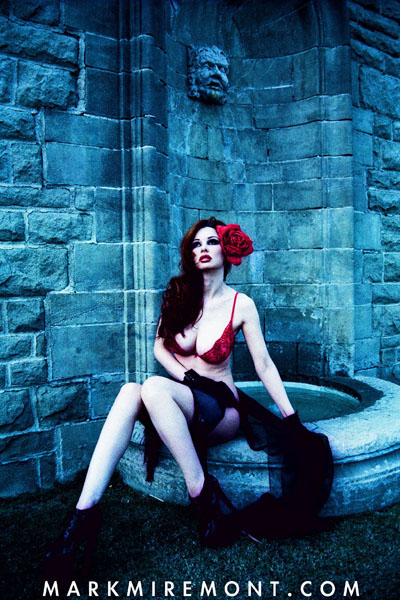
The Resurrection of Beauty
A Manifesto for 21st
Century Art
Mark Miremont
Previously. The 20th century saw innovations in science and
these accelerated technological, medical, social and political
innovations at a rate unparalleled in human history. From the horse
drawn carriage and wood fire, we progressed to space travel and nuclear
fusion. Likewise, the arts progressed from realism to impressionism to
dada to minimalism to post-modernism, and so on.
Now.
Here we stand in the 21st century. The progress of science
and art has brought a marriage of marvels and horrors.
The
worst of the horrors grew from a cynical relativism. In science, it
could be the physicist who thinks just because he can, he should design
bombs that can kill millions of people. In art, it could be the artist
who thinks just because he can, he should say a urinal in a gallery is
art.
What we
value creates culture. Culture informs action. Action defines history.
History determines the present.
The
values of the 20th century have led us to where we are now.
The
sarcastic relativism of dada has been widely embraced by the collectors,
museums and publications that profit from the marketing of its
philosophy. Its impact has been felt in all aspects of western culture.
So much so that Beauty is commonly believed to have no place in art.
From Wilde to Serra, it has been argued that Art has no use. Indeed the
word 'art' has been rendered meaningless, as anything can be art,
if so named.
This is
cynicism. This is nihilism. This is the art world in the first steps of
the 21st century.
Sarcasm, empty intellectualism, decay and
the desperate need to shock have been in vogue for too long now.
We do not doubt the genius of dada
questioning what art can be. Yet, the values derived from anti-art's
nihilistic ontology do not free us, they doom us.
Just as
we continue to search for meaning after Nietzsche's madman claimed, "God
is Dead", so too we still search for Beauty after dada raped art.
It is easier to desecrate something of
Beauty than to create something of Beauty. The former is lazy
intellectualism at best. The latter is the path of art.
Perhaps
because he could not create it at the time, Duchamp sought to de-value
Beauty. And as his followers fetishize the early works of dada, his
philosophy has paradoxically become the status quo.
The resurrection of Beauty will be
resisted at first. It will be called naive, superficial and simplistic.
The pretense of the critics will be similar to that which Duchamp sought
to obliterate with his readymades.
Here, now, it is far more revolutionary to
be sincere, romantic and idealistic.
And while we
reject the values derived from 20th century relativism, this
does not make us neo-classicists.
Classifications are meaningless to anyone seeking Beauty.
There were
works lacking Beauty before dada and there have been works of Beauty
despite dada.
Beauty can bridge any chasm and should be
the goal of every culture.
Beauty
is the purpose of art, just as a building is the purpose of
architecture.
The
utility of art is to inform us of Beauty, just as the utility of science
is to inform us of truth.
Beauty is a fundamental need of the
healthy human condition, like oxygen.
Dysfunction in the individual, the family,
the society and the world is often due to a lack of Beauty.
This is our destiny: to resurrect Beauty
and to rally others to do the same. Think of what art could be in the 22nd
century. Then the 23rd. Does empty relativism provide a path
that will bring about something new and meaningful?
Again.
What we value creates culture. Culture informs action. Action defines
history.
Enjoy the 2 minute trailer for his new film, THE RESURRECTION OF BEAUTY
|
|